
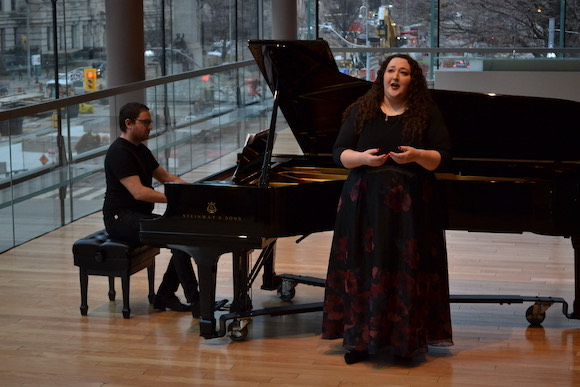
Bourgie Hall and the Montreal Holocaust Museum will present the Likht Ensemble – Kishef, a profoundly moving musical program taking place on Sunday, January 18 ( 2:30 p.m. ) at Bourgie Hall of the Montreal Museum of Fine Arts downtown (1339 Sherbrooke Street West)..
This unique event, performed by the Likht Ensemble, will feature soprano Jaclyn Grossman (Https://www.jaclyngrossman.com/), and pianist Nate Ben-Horin (https://www.natebenhorin.com/) . The concert will honour the enduring creative voices of Jewish composers whose work emerged during one of history’s darkest eras. In recognition of this presentation, Bourgie Hall is offering a 30 percent discount on tickets with the promotional code CONCERT30. Using this promo code also grants access to a post-concert Meet and Greet with the artists.
Magic
“Kishef,” the Yiddish word for magic, captures the spirit that sustained countless artists during the years leading up to and throughout the Second World War. The program features new arrangements of songs written in the Czech and Lithuanian ghettos, music that preserves and amplifies the testimony of individuals who resisted destruction through creativity. The concert also includes a new commission from Ben-Horin, created especially for Bourgie Hall, furthering the tradition of remembrance through contemporary artistic expression.
Presented in the lead-up to International Holocaust Remembrance Day on January 27, Kishef serves as a reminder of the vital role that art plays in commemoration. By bringing these works to the stage, the Likht Ensemble pays tribute not only to the victims and survivors of the Holocaust, but also to the culture and music that endured despite attempts to silence it. The concert invites audiences to reflect on the resilience preserved in these songs and the responsibility we share in carrying their stories forward.
Through this partnership, the Montreal Holocaust Museum reaffirms its commitment to Holocaust education, remembrance, and the promotion of survivor testimonies — with Bourgie Hall serving as a partner in this special project, helping these voices continue to resonate through the music they left behind.
San Francisco Native
While in Toronto in December, I sat down with Ben-Horin, whose training is in opera/classical music. He says he always had a toe in folksier musical waters, including Jewish tunes. Originally from San Francisco, he has lived in Canada since 2018 (with an errant year in Ohio). Ben-Horin and Grossman met at grad school at McGill University. “Around that same time, Jaclyn was first exposed to Holocaust music while researching a Jewish-themed recital as a recipient of the Ben Steinberg Musical Legacy Award from Temple Sinai,” he explained. “Then, just as we were about to graduate, the pandemic stopped the opera industry in its tracks. With live performance out of the question and a lot of free time, we began a deep dive into Holocaust music, and were awestruck by what we found. Some of the music written in the camps was so outstanding that we couldn’t believe we had never heard it before.
The Shoah Songbook
“We began a process of researching, reaching out, and experimenting that led to us writing (and receiving) our first grants, and ultimately connecting with Harold Green Jewish Theatre Company, who platformed our flagship project The Shoah Songbook, a series of digital recitals. To date, we’ve made three of these, focusing on music from Terezín (a Czech ghetto), Lithuania and Poland respectively. Each one is a potpourri of formal classical song, original arrangements of folk tunes, and other styles like cabaret. Often the materials that we work from are obscure digital scans of crinkled, barely-legible handwritten melodies, with incredible backstories of how they were created, discovered and preserved, so realizing these concerts is both a challenge and a privilege.”
Grossman and Ben-Horin are musical partners and best friends. A few years ago they travelled to the U.S. Holocaust Museum in Washington. “Our trip was basically a week of frantic photocopying, which is to say we collected a ton of material from the museum archives ,” Ben-Horin said
Grossman says that composing and performing in Yiddish is such a fun and flavourful language. “Being steeped in German from our classical background, it’s so interesting how much Yiddish is intelligible without ever having formally studied it — German vocabulary with a heap of Jewish seasoning,” she said. “In fact, a few of our composers have written about their intrinsic connection to German culture, and the sense of betrayal that accompanied the Nazi takeover. It’s a fascinating topic, and you can really sense this cultural intertwinedness in the Yiddish language!”
Silenced Before Their Time
It was emotional to hear Ben-Horin tell me the story of some of the composers from the Holocaust who were silenced before their time, ranging from the subtle poetry and haunting lullabies of Ilse Weber, to the stylistically advanced works of Viktor Ullmann, to the never-before-recorded songs of Miriam Harel, and much more.
I asked Grossman how many people are actually not familiar with the number of compositions that exist from people who perished in the Holocaust. “We were unaware ourselves until 2020,” she admits. “Then we turned to research.”
Grossman has performed across Canada and in Europe in different operatic concerts, including as Freia in Das Rheingold with Edmonton Opera and the Buffalo Philharmonic as the soprano soloist in Beethoven’s 9th Symphony under JoAnn Falletta. Ben-Horin works internationally as a répétiteur and vocal coach, including recent stints with Opera Columbus, Vancouver Opera, and the Wexford Festival Opera in Ireland.
“An important part of our uncovering work is reconstruction,” said Grossman. “Many if not most of the songs we come across are field recordings or field transcriptions of unaccompanied vocal melodies. Part of Nate’s job is to notate these melodies and create instrumental accompaniment parts from scratch so that these tunes can be performed in a classical recital setting.”
Target Audience
Who is the target audience? Ben-Horin said that in addition to the Jewish community, anyone who enjoys classical music will appreciate it not to mention reps from the various cultural communities who regularly support the work of the Montreal Holocaust Museum.
Could this be the start of something really big for the duo ? “We really hope so,” Grossman says. “In fact we are booked to perform in Vienna and Munich in March. While we are there we will do even more research.”
The concert will be 75 minutes, plus an intermission.
Tickets are available at: https://www.mbam.qc.ca/en/activities/likht-ensemble-kishef/
Bonus Material: The Program=
Nate has provided me with this additional material for attendees.
We open our program with a set of songs by Ilse Weber (1903–1944), a Czech-German playwright, children’s author, and songwriter.
Weber’s letters and poems (collected posthumously as Dancing on a Powder Keg) reveal a charismatic personality with a strikingly clear-eyed perspective on the shifting cultural landscape of interwar Central Europe. The songs on tonight’s program were written in the Bohemian camp of Theresienstadt (Terezín), which—despite its function as a transit camp—housed a remarkable concentration of artists and intellectuals who formed an astonishing creative community under catastrophic conditions. Weber’s songs were reportedly buried in a tool shed prior to her deportation to Auschwitz and later retrieved by her husband, Willi Weber, who survived the war.
Ich wandre durch Theresienstadt (“I Wander Through Theresienstadt”) has a sweet, Schubertian sense of journey, while its text pulls no punches in describing despair and deprivation. Ukolebavka (“Lullaby”) unfolds as a luminous melody with sumptuous, Czech-inflected harmonies by an unknown arranger. Und der Regen rinnt (“And the Rain Pours Down”) is a letter-song addressed to Weber’s older son, Hanuš, whom she managed to save by sending him safely abroad; the song expresses both longing and gratitude that he is not present in the camp.
The remaining songs in the first half of the program are drawn from our digital recital Shoah Songbook: Lithuania, developed for the Harold Green Jewish Theatre, which highlights music primarily from the Kovno and Vilna ghettos.
Oyfn Pripetchik (“By the Hearth”), by Mark Warshawsky, is among the most widely known of all Yiddish songs. Written in the late nineteenth century, it has achieved an almost immortal status within Jewish musical culture. The song depicts a rabbi seated by the fireside, teaching young children the Hebrew alphabet (alef-beys) so that they may read the Torah. He tells them that those who can read the Torah are supremely fortunate, yet also reminds them that each letter is etched in pain, for the sacred texts recount “a life full of tears.”
Three Lithuanian Songs by Edwin Geist were composed while he was imprisoned in the Kovno Ghetto. Geist was a German composer who had fled to Lithuania after being barred from professional life under Nazi racial laws. Schwerer Abend (“Heavy Evening”) evokes an uncanny nocturnal image; Seeballade (“Song of the Lake”) presents a mystical waterscape with clear Wagnerian musical and symbolic resonances; and Dynamik des Frühlings (“Dynamic of the Spring”) pulses with a sense of danger and violent renewal. The manuscripts of these works were rescued when a friend broke into Geist’s sealed apartment after he was shot by the Nazis following a failed escape attempt. Still unpublished, the songs survive through scans of the handwritten manuscripts now held in the archives of the United States Holocaust Memorial Museum.
Several further songs illustrate different kinds of folk response to ghetto life. Zingt un tanst in ridelekh (“Sing and Dance in Circles,” anonymous) exemplifies the practice of retexting an existing melody—in this case, a nursery rhyme—with new words describing immediate surroundings, here a sinister visit marked by surveillance and intimidation from the ghetto authorities. Ein Traum (“A Dream”), by Percy Haid, is a cinematic fantasy: a vision of love unfolding in the midst of Dachau. Friling (“Spring”), with words by Shmerke Kaczerginski and music by Abraham Brudno, portrays a despondent wander through the ghetto streets after the death of the poet’s wife, pleading with spring to carry him away on its blue wings and restore his happiness. Although the song is often adapted as a slow, mournful tango, an archival recording of Kaczerginski himself singing it after the war reveals a punchier delivery; our arrangement reflects that spirit, drawing on the rhythmic drive of Jewish popular song traditions.
After intermission, we turn to “Karussell,” written in 1944 in the Theresienstadt (Terezín) ghetto, with music by Martin Roman and lyrics by Manfred Greiffenhagen. The song was the title number of a large cabaret revue directed by Kurt Gerron, a well-known German-Jewish actor and filmmaker imprisoned in Terezín. Its text describes riders on wooden horses, turning in circles on a journey with no destination. The song was performed repeatedly in Terezín in the final months before the deportation and murder of nearly all of the artists involved. Roman, a prominent jazz pianist of the 1920s and 30s, survived Terezín and Auschwitz and resumed his music career after the war.
We then present Kishef Songs, by Nate Ben-Horin, commissioned by Salle Bourgie. Kishef means “magic” or “witchcraft” in Yiddish. In moments of extreme darkness, there is often an impulse to seek magic in the form of hope, possibility, or even impossible solutions. While folk magic was historically prohibited by Jewish religious authorities, appeals to supernatural agency persisted through invocations of holy names, kabbalistic letter permutations, protective superstitions, and folk remedies.
The cycle offers three glimpses of what might be called “modern magic,” each with a Jewish inflection. Everyday Magic draws on the familiar Yiddish and Hebrew phrase im yirtze haShem (“if God is willing”), traditionally appended to statements both trivial and momentous: “I’ll see you Thursday, im yirtze haShem,” “I’ll turn eighty-five this year, im yirtze haShem.” The phrase carries an intrinsic awareness of life’s uncertainty, paired with an affirmation that the mystical and the mundane are inseparable; everyday actions belong to a larger divine fabric. The Secret highlights the magical mystique of an untold truth—something almost but not quite known, something that should not be real, as well as the power of the secret-teller. In a Dark Place refers to the phenomenon sometimes described as Holocaust dreams, in which later-generation descendants of survivors report imagery associated with camps or flight despite no direct lived memory. Its childlike, casual tone leaves the experience unexplained, pointing instead to the mystery of how fear and emotion can be inherited through culture.
The program concludes with Six Sonnets de Louise Labé, Op. 34, by Viktor Ullmann. Ullmann composed the cycle in Prague in 1941, during a period when Nazi occupation had stripped Jewish artists of public platforms. Forbidden from performing publicly, he turned to the poetry of the sixteenth-century French writer Louise Labé, setting six of her sonnets in the original French—a striking departure from the German Lied tradition. The work was dedicated to his third wife, Elisabeth Ullmann, and stands among the last pieces he completed before his deportation to Theresienstadt in September 1942.
The cycle survived only because friends preserved Ullmann’s manuscripts, and it entered the repertoire decades later as part of the broader rediscovery of composers silenced by the Holocaust. The harmonic language is intensely chromatic, often balancing overlapping tonal centers with moments of lyric clarity. The piano writing is dense and expressive, while the vocal lines are marked by wide intervallic leaps and sustained cantabile intensity.
Each sonnet occupies a distinct expressive world. Clere Vénus (“Bright Venus”) opens with a restrained invocation of the goddess of love, colored by delicate harmonic instability. On voit mourir (“One sees [love] die”) deepens this introspection, while Je vis, je meurs (“I live, I die”) erupts with violent urgency, its obsessive piano figures and vaulting vocal line mirroring the poem’s emotional extremes. Lut, compagnon (“Lute, companion”) introduces imitative textures that evoke the lute imagery of the text. Baise m’encore (“Kiss me again”) responds to Labé’s unabashed eroticism with feverish momentum and rhythmic drive. The final song, Oh si j’étois en ce beau sein ravie (“Oh, if I could be ravished in that fair breast”) withdraws into a rocking, dreamlike calm, offering a fragile vision of repose.
Louise Labé, a central figure of the Lyon Renaissance, wrote with a frankness and sensual intensity that was extraordinary for a woman of her time. By setting her poetry in 1941, Ullmann created a dialogue across four centuries: Renaissance longing refracted through a modernist musical language forged under persecution. The convergence of these voices affirms the persistence of love, imagination, and artistic truth in the face of historical rupture.
By Mike Cohen
